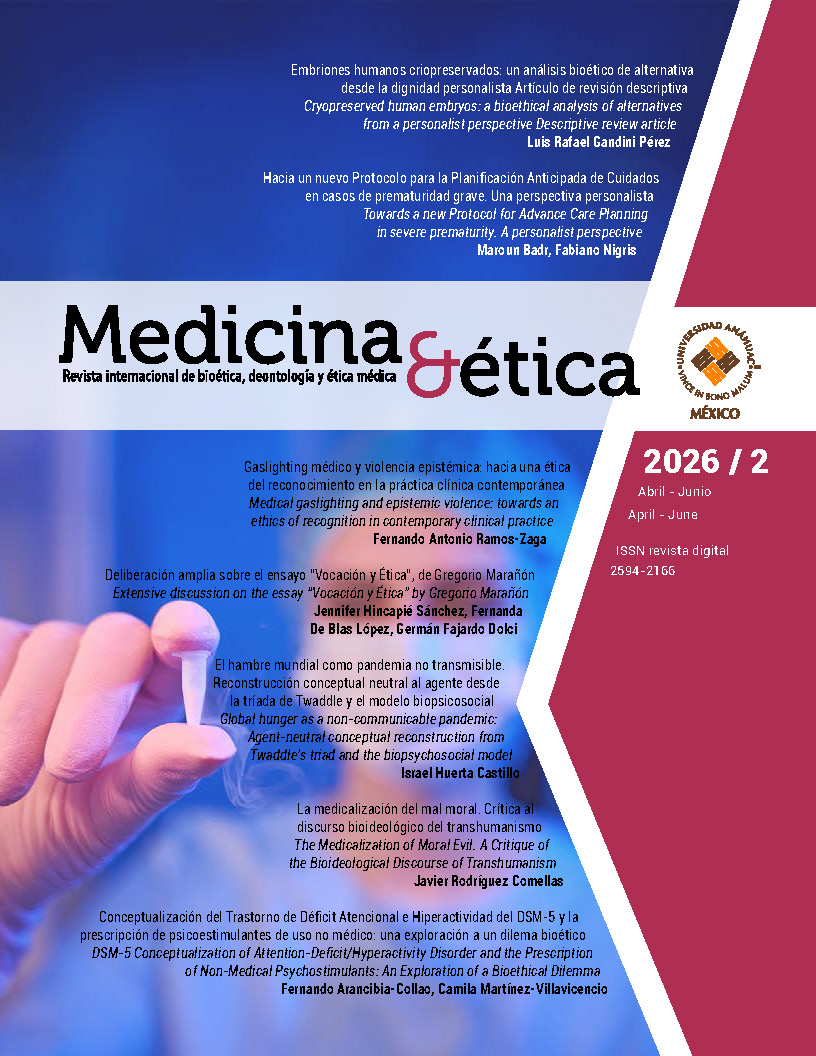
Gaslighting médico y violencia epistémica: hacia una ética del reconocimiento en la práctica clínica contemporánea
DOI:
https://doi.org/10.36105/mye.2026v37n2.03Resumen
El gaslighting médico, entendido como una forma de manipulación institucional que desacredita la experiencia del paciente, representa una manifestación estructural de violencia epistémica que deteriora la confianza clínica y transforma la atención sanitaria en un espacio de exclusión cognitiva. En ese sentido, el objetivo del presente artículo es analizar críticamente el gaslighting médico como forma de violencia epistémica y ontológica a partir del caso Kowalski, con el propósito de delinear criterios y mecanismos institucionales orientados a la transformación ética del vínculo clínico. El análisis revela tres dinámicas estructurales interrelacionadas: el descrédito testimonial, que invalida la voz del paciente; la patologización afectiva, que reinterpreta su sufrimiento como signo de irracionalidad; así como la reescritura institucional del dolor, que impone una versión oficial del padecimiento. Se concluye que la superación del gaslighting médico requiere reconfigurar la práctica sanitaria sobre los principios de justicia epistémica, reconocimiento intersubjetivo y humildad cognitiva, condición indispensable para restaurar la confianza y la legitimidad moral de la medicina contemporánea.
Descargas
Referencias
1. Foucault M. The birth of the clinic: An archaeology of medical perception. London: Tavistock Publications; 1976.
2. Gadamer HG. The enigma of health: The art of healing in a scientific age. Stanford: Stanford University Press; 1993.
3. Fricker M. Epistemic injustice: Power and the ethics of knowing. Oxford: Oxford University Press; 2007. DOI: https://doi.org/10.1093/acprof:oso/9780198237907.001.0001
4. Carel H. Phenomenology of illness. Oxford: Oxford University Press; 2016. DOI: https://doi.org/10.1093/acprof:oso/9780199669653.001.0001
5. Honneth A. The struggle for recognition: The moral grammar of social conflicts. Cambridge: MIT Press; 1995.
6. Luna F. Identifying and evaluating layers of vulnerability: A way forward. Dev World Bioeth. 2020; 20(2):86-95. https://doi.org/10.1111/dewb.12206 DOI: https://doi.org/10.1111/dewb.12206
7. Pellegrino ED. Moral choice, the good of the patient, and the patient’s good. In: Moskop J, Kopelman L, editors. Ethics and critical care medicine. Dordrecht: Reidel; 1985. DOI: https://doi.org/10.1007/978-94-009-5233-1_9
8. Beauchamp TL, Childress JF. Principles of biomedical ethics. 6th ed. Oxford: Oxford University Press; 2009.
9. Feldman S, Ammar W, Lo K, Trepman E, van Zuylen M, Etzioni O. Quantifying sex bias in clinical studies at scale with automated data extraction. JAMA Netw Open. 2022; 5(7):e2224565. Disponible en: https://jamanetwork.com/journals/jamanetworkopen/fullarticle/2737103
10. Topol E. Deep medicine: How artificial intelligence can make healthcare human again. New York: Basic Books; 2019.
11. Tronto JC. Moral boundaries: A political argument for an ethic of care. New York: Routledge; 1993.
12. Schramm FR. Bioética de proteção: Ferramenta válida para enfrentar problemas morais na era da globalização. Rev Bioét. 2018; 26(1):11-23. Disponible en: https://revistabioetica.cfm.org.br/revista_bioetica/article/view/52
13. Carel H, Kidd IJ. Epistemic injustice in healthcare: A philosophical analysis. Med Health Care Philos. 2014; 17(4):529-40. Disponible en: https://link.springer.com/article/10.1007/s11019-014-9560-2 DOI: https://doi.org/10.1007/s11019-014-9560-2
14. Simborg S. Medical child abuse, Munchausen syndrome by proxy, and pediatric condition falsification: A critical review of the literature. Psychol Public Policy Law. 2022; 28(3):362-79. https://doi.org/10.1007/s11894-017-0553-1 DOI: https://doi.org/10.1007/s11894-017-0553-1
15. Pellegrino ED. The metamorphosis of medical ethics: A 30-year retrospective. JAMA. 1993; 269(9):1158-62. https://doi.org/10.1001/jama.1993.03500090094039 DOI: https://doi.org/10.1001/jama.1993.03500090094039
16. Karkazis K, Jordan-Young R. Testosterone: An unauthorized biography. Cambridge: Harvard University Press; 2019. DOI: https://doi.org/10.4159/9780674242647
17. Ricoeur P. Oneself as another. Chicago: University of Chicago Press; 1990.
18. Frank AW. The wounded storyteller: Body, illness, and ethics. Chicago: University of Chicago Press; 1995. DOI: https://doi.org/10.7208/chicago/9780226260037.001.0001
19. Lindemann H. Holding and letting go: The social practice of personal identities. Oxford: Oxford University Press; 2014. DOI: https://doi.org/10.1093/acprof:oso/9780199754922.001.0001
20. Sweet PL. The sociology of gaslighting. Am Sociol Rev. 2019; 84(5):851-75. Disponible en: https://www.asanet.org/wp-content/uploads/attach/journals/oct19asrfeature.pdf DOI: https://doi.org/10.1177/0003122419874843
21. Habermas J. The theory of communicative action, Volume 1: Reason and the rationalization of society. Boston: Beacon Press; 1984.
22. Dussel E. Ética de la liberación en la edad de la globalización y de la exclusión. Madrid: Trotta; 1998. DOI: https://doi.org/10.7202/401177ar
Descargas
Publicado
Número
Sección
Licencia
Derechos de autor 2026 Fernando Antonio Ramos-Zaga

Esta obra está bajo una licencia internacional Creative Commons Atribución-NoComercial-CompartirIgual 4.0.
Medicina y Ética se distribuye bajo Licencia Creative Commons Atribución-NoComercial-CompartirIgual 4.0 Internacional.
El autor conserva los derechos patrimoniales sin restricciones y garantiza a la revista el derecho de ser la primera publicación del trabajo. El autor es libre de depositar la versión publicada en cualquier otro medio, como un repositorio institucional o en su propio sitio web.