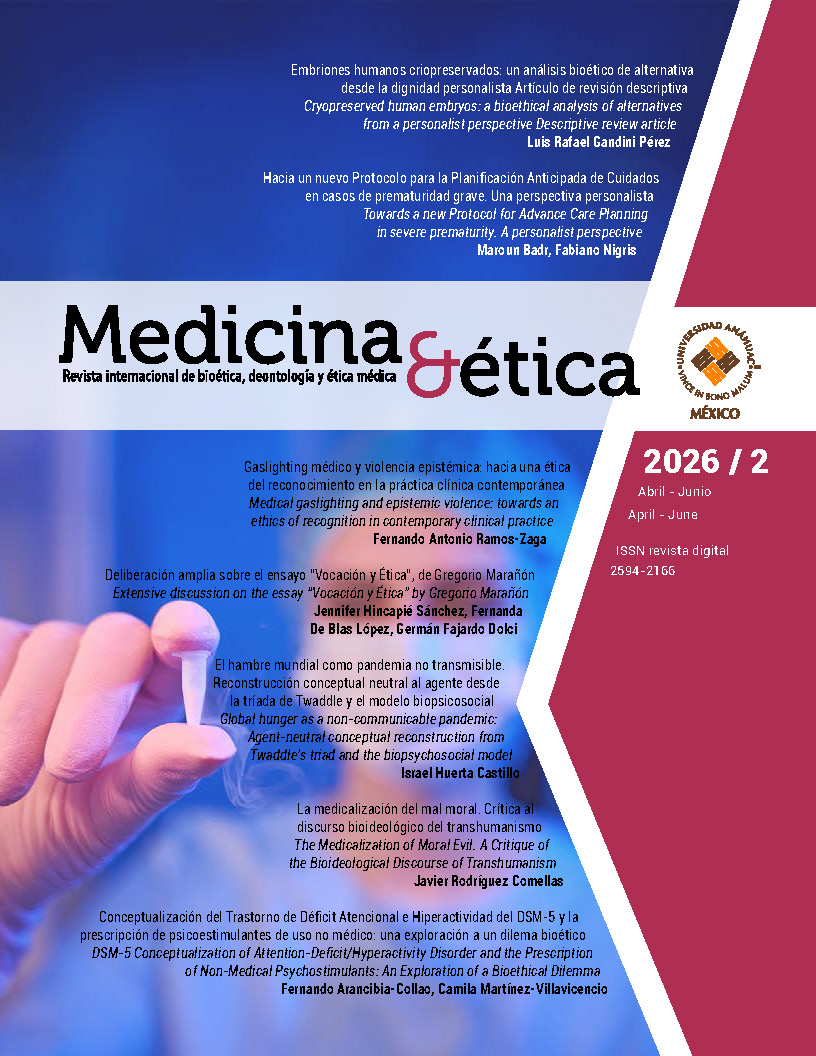
Conceptualización del Trastorno de Déficit Atencional e Hiperactividad del DSM-5 y la prescripción de psicoestimulantes de uso no médico: una exploración a un dilema bioético
DOI:
https://doi.org/10.36105/mye.2026v37n2.07Palabras clave:
medicalización, psicoestimulantes, TDAH, dilema bioéticoResumen
El artículo analiza la evolución histórica del TDAH y su estrecha relación con el uso de psicoestimulantes, mostrando cómo cambios diagnósticos, evidencia clínica y presiones sociales han configurado su comprensión contemporánea. Aunque los estimulantes reducen síntomas y riesgos asociados al TDAH, su fundamento neurobiológico sigue siendo incierto y la expansión diagnóstica ha favorecido fenómenos de sobrediagnóstico y medicalización. El uso no médico —especialmente en contextos educativos y laborales— visibiliza un dilema bioético central: la creciente difuminación entre tratamiento y optimización del rendimiento. Se examinan críticas epistémicas a los ensayos clínicos, la influencia de la industria farmacéutica, los efectos identitarios del diagnóstico y las tensiones entre autonomía, justicia y cuidado. El artículo propone fortalecer una ética institucional que limite intereses comerciales, garantice transparencia en la construcción diagnóstica y promueva una comprensión más amplia del malestar atencional, integrando dimensiones biológicas, sociales y culturales.
Descargas
Referencias
1. American Psychiatric Association. Diagnostic and statistical manual of mental disorders (DSM-5). American Psychiatric Publishing, Inc.; 2013. https://doi.org/10.1176/appi.books.9780890425596
2. Faraone SV, Bellgrove MA, Brikell I, Cortese S, Hartman CA, Hollis C. Attention-deficit/hyperactivity disorder. Nature Reviews Disease Primers. 2024; 10(1):1-21. Avaliable at: https://doi.org/10.1038/s41572-024-00495-0
3. Lieslehto J, Tiihonen J, Lähteenvuo M, Mittendorfer-Rutz E, Tanskanen A, Taipale H. Comparative Effectiveness of Pharmacotherapies for the Risk of Attempted or Completed Suicide among Persons with Borderline Personality Disorder. JAMA Network Open. 2023; 6(6). https://doi.org/10.1001/jamanetworkopen.2023.17130
4. Li L, Coghill D, Sjolander A, Yao H, Zhang L, Kuja-Halkola R. Increased Prescribing of Attention-Deficit/Hyperactivity Disorder Medication and Real- World Outcomes Over Time. JAMA Psychiatry. 2025; 82;(8):830-837. https://doi.org/10.1001/jamapsychiatry.2025.1281
5. Sultan RS, Saunders DC, Veenstra-Vanderweele J. Protective Effects of ADHD Medication on Real-World Outcomes. JAMA Psychiatry. 2025; 82;(8):757-758. https://doi.org/10.1001/jamapsychiatry.2025.0918
6. Faraone SV, Rostain AL, Montano CB, Mason O, Antshel KM, Newcorn JH. Systematic Review: Nonmedical Use of Prescription Stimulants: Risk Factors, Outcomes, and Risk Reduction Strategies. Journal of the American Academy of Child & Adolescent Psychiatry [Internet]. 2020; 59. https://doi.org/10.1016/j.jaac.2019.06.012
7. Wilens T, Zulauf C, Martelon MK, Morrison NR, Simon A, Carrellas NW. Nonmedical stimulant use in college students: Association with attention- deficit/hyperactivity disorder and other disorders. Journal of Clinical Psychiatry. 2016; 77(7):940-7. https://doi.org/10.4088/JCP.14m09559
8. Novak SP, Kroutil LA, Williams RL, Van Brunt DL. The nonmedical use of prescription ADHD medications: results from a national Internet panel. Substance Abuse Treatment, Prevention, and Policy. 2007; 2(32). https://doi.org/10.1186/1747-597X-2-32
9. Cassidy TA, Varughese S, Russo L, Budman SH, Eaton TA, Butler SF. Nonmedical Use and Diversion of ADHD Stimulants Among U.S. Adults Ages 18-49: A National Internet Survey. Journal of Attention Disorders. 2015; 19(7):630-40.
10. Arria AM, Caldeira KM, Vincent KB, Q’Grady KE, Cimini MD, Geisner 1M. Do college students improve their grades by using prescription stimulants nonmedically? Addictive Behaviors. 2017; 65:245-9. https://doi.org/10.1016/j.addbeh.2016.07.016
11. Cropsey KL, Schiavon S, Hendricks PS, Froelich M, Lentowicz 1, Fargason R. Mixed-amphetamine salts expectancies among college students: 1s stimulant induced cognitive enhancement a placebo effect? Drug and Alcohol Dependence. 2017; 178:302-9. https://doi.org/10.1016/j.drugalcdep.2017.05.024
12. Looby A, Earleywine M. Expectation to receive methylphenidate enhances subjective arousal but not cognitive performance. Experimental and Clinical Psychopharmacology. 2011; 19(6):433-44. https://doi.org/10.1037/a0025252
13. McCabe SE, Veliz P, Wilens TE, Schulenberg JE. Adolescents’ Prescription Stimulant Use and Adult Functional Outcomes: A National Prospective Study. Journal of the American Academy of Child and Adolescent Psychiatry. 2017; 56(3):226-34. https://doi.org/10.1016/j.jaac.2016.12.008
14. Peterkin AL, Crone CC, Sheridan MJ, Wise TN. Cognitive performance enhancement: Misuse or self-treatment? Journal of Attention Disorders. 2011; 15(4):263-8. https://doi.org/10.1177/1087054710365980
15. Weyandt LL, White TL, Gudmundsdottir BG, Nitenson AZ, Rathkey ES, De Leon KA. Neurocognitive, Autonomic, and Mood Effects of Adderall: A Pilot Study of Healthy College Students. Pharmacy. 2018; 6(3):58. https://doi.org/10.3390/pharmacy6030058
16. Martinez-Badía J. Who says this is a modern disorder? The early history of attention deficit hyperactivity disorder. World Journal of Psychiatry. 2015; 5(4):379. https://doi.org/10.5498/wjp.v5.i4.379
17. Still GF. Some abnormal psychical conditions in children: excerpts from three lectures. Journal of Attention Disorders. 2006; 10(2):126-36. https://doi.org/10.1177/1087054706288114
18. Bradley C. The behavior of children receiving Benzedrine. American Journal of Psychiatry. 2006; 94(3):577-85. https://doi.org/10.1176/AJP.94.3.577
19. Laufer MW, Denhoff E, Solomons G. Hyperkinetic impulse disorder in children’s behavior problems. Journal of Attention Disorders. 2011; 15(8):620-5. https://doi.org/10.1177/1087054711413043
20. Laufer MW, Denhoff E. Hyperkinetic behavior syndrome in children. The Journal of Pediatrics. 1957; 50(4):463-74. https://doi.org/10.1016/S0022-3476(57)80257-1
21. Mayes R, Bagwell J, Erkulwater CL. Medicating Children: ADHD and Pediatric Mental Health [1nternet]. Harvard University Press; 2009. https://doi.org/10.2307/j.ctv228vqx9
22. Wender PH. The minimal brain dysfunction syndrome in children. 1. The syndrome and its relevance for psychiatry. 11. A psychological and biochemical model for the syndrome. The Journal of Nervous and Mental Disease. 1972; 155(1):55-71. https://doi.org/10.1097/00005053-197207000-00007
23. Rosenthal RH, Allen TW. An examination of attention, arousal, and learning dysfunctions of hyperkinetic children. Psychological Bulletin. 1978; 85(4):689-715. https://doi.org/10.1037/0033-2909.85.4.689
24. Wood DR, Reimherr FW, Wender PH, Johnson GE. Diagnosis and treatment of minimal brain dysfunction in adults: a preliminary report. Archives of General Psychiatry. 1976; 33(12):1453-60. https://doi.org/10.1001/archpsyc.1976.01770120057005
25. Clements SD, Peters JE. Minimal Brain Dysfunctions in the School-Age Child: Diagnosis and Treatment. Archives of General Psychiatry. 1962; 6(3):185-97. https://doi.org/10.1001/archpsyc.1962.01710210001001
26. Douglas VI. Stop, look and listen: The problem of sustained attention and impulse control in hyperactive and normal children. Canadian Journal of Behavioural Science I Revue Canadienne Des Sciences Du Comportement. 1972; 4(4):259-82. https://doi.org/10.1037/h0082313
27. Feingold BF. Hyperkinesis and Learning Disabilities Linked to Artificial Food Flavors and Colors. The American Journal of Nursing [Internet]. 1975; 75(5). Avaliable at: https://doi.org/10.2307/3423460
28. Conrad P. The discovery of hyperkinesis: notes on the medicalization of deviant behavior. Social Problems. 1975; 23(1):12-21. https://doi.org/10.2307/799624
29. Glow PH, Glow RA. Hyperkinetic impulse disorder: a developmental defect of motivation. Genetic Psychology Monographs. 1979; 100 (Second Half):159-231.
30. American Psychiatric Association. Diagnostic and statistical manual of mental disorders (DSM III). 3a ed. American Psychiatric Publishing, Inc.; 1980. https://psychiatryonline.org/doi/abs/10.1176/appi.books.9780521315289.dsm-iii
31. Conners CK. Forty years of methylphenidate treatment in Attention- DeficitIHyperactivity Disorder. Journal of Attention Disorders. 2002; 6. https://journals.sagepub.com/doi/10.1177/070674370200601S04
32. Faraone SV, Buitelaar J. Comparing the efficacy of stimulants for ADHD in children and adolescents using meta-analysis. European Child and Adolescent Psychiatry. 2010; 19(4):353-64. https://doi.org/10.1007/s00787-009-0054-3
33. Swanson JM, Mcburnett K, Wigal T, Pfiffner LJ, Lerner MA, Williams L. Effect of Stimulant Medication on Children with Attention Deficit Disorder: A Review of Reviews. Exceptional Children. 1993; 60(2):154-62. https://doi.org/10.1177/001440299306000209
34. Barkley RA. Attention-deficit hyperactivity disorder: A handbook for diagnosis and treatment, 4th ed. Barkley RA, editor. New York: The Guilford Press; 2015. https://doi.org/10.1080/16506073.2015.1073786
35. Conners CK. History of attention-deficit hyperactivity disorder (ADHD). En: Attention-Deficit Hyperactivity Disorder in Adults and Children. Cambridge University Press; 2015. https://doi.org/10.1017/CBO9781139035491.002
36. Jensen PS, Hinshaw SP, Swanson JM, Greenhill LL, Conners CK, Arnold EL. Findings from the NIMH Multimodal Treatment Study of ADHD (MTA): Implications and applications for primary care providers. Journal of Developmental and Behavioral Pediatrics. 2001; 22(1):60-73. https://doi.org/10.1097/00004703-200102000-00008
37. American Psychiatric Association. Diagnostic and statistical manual of mental disorders (DSM-IV). American Psychiatric Publishing, Inc.; 1994. https://doi.org/10.1176/appi.books.9780890420614.dsm-iv
38. Castellanos FX, Giedd JN, Marsh WL, Hamburger SD, Vaituzis AC, Dickstein DP. Quantitative brain magnetic resonance imaging in attention-deficit hyperactivity disorder. Archives of General Psychiatry. 1996; 53(7):607-16. https://doi.org/10.1001/archpsyc.1996.01830070053009
39. Friedman LA, Rapoport JL. Brain development in ADHD. Current Opinion in Neurobiology. 2015; 30:106-11. https://doi.org/10.1016/j.conb.2014.11.007
40. Fulton BD, Scheffler RM, Hinshaw SP. State variation in increased ADHD prevalence: Links to NCLB school accountability and state medication laws. Psychiatric Services. 2015; 66(10):1074-82. https://doi.org/10.1176/appi.ps.201400145
41. Schneider H, Eisenberg D. Who receives a diagnosis of attention- deficit/hyperactivity disorder in the United States elementary school population? Pediatrics. 2006; 117(4). https://doi.org/10.1542/peds.2005-1308
42. Swanson JM, Volkow ND. Psychopharmacology: concepts and opinions about the use of stimulant medications. Journal of Child Psychology and Psychiatry, and Allied Disciplines. 2009; 50(1-2):180. https://doi.org/10.1111/j.1469-7610.2008.02062.x
43. Hadland SE, Cerdá M, Earlywine JJ, Krieger MS, Anderson TS, Marshall BDL. Analysis of Pharmaceutical Industry Marketing of Stimulants, 2014 Through 2018. JAMA Pediatrics. 2020; 174(4):385. https://doi.org/10.1001/jamapediatrics.2019.5526
44. Morris-Rosendahl DJ, Crocq MA. Neurodevelopmental disorders-the history and future of a diagnostic concept. Dialogues in Clinical Neuroscience. 2020; 22(1):65-72. https://doi.org/10.31887/DCNS.2020.22.1/macrocq
45. Thapar A, Cooper M, Rutter M. Neurodevelopmental disorders. The Lancet Psychiatry. 2017; 4(4):339-46. https://doi.org/10.1016/S2215-0366(16)30376-5
46. Barkley RA, Murphy KR, Fischer M. ADHD in adults: What the science says. The Guilford Press; 2008. https://doi.org/10.1177/1087054709333321
47. Biederman J, Faraone SV, Spencer T, Wilens T, Norman D, Lapey KA. Patterns of psychiatric comorbidity, cognition, and psychosocial functioning in adults with attention deficit hyperactivity disorder. American Journal of Psychiatry. 1993; 150(12):1792-8. https://doi.org/10.1176/ajp.150.12.1792
48. Conrad P, Bergey MR. The impending globalization of ADHD: Notes on the expansion and growth of a medicalized disorder. Social Science & Medicine. 2014; 122:31-43. https://doi.org/10.1016/j.socscimed.2014.10.019
49. Hunt AD, Procyshyn TL. Changing perspectives on autism: Overlapping contributions of evolutionary psychiatry and the neurodiversity movement. Autism Research. 2024; 17(3):459-66. https://doi.org/10.1002/aur.3078
50. Thapar A, Riglin L. The importance of a developmental perspective in Psychiatry: what do recent genetic-epidemiological findings show? Molecular Psychiatry. 2020; 25(8):1631-9. https://doi.org/10.1038/s41380-020-0648-1
51. Biederman J, Monuteaux MC, Mick E, Spencer T, Wilens TE, Silva JM. Young adult outcome of attention deficit hyperactivity disorder: A controlled 10-year follow-up study. Psychological Medicine. 2006; 36(2):167-79. https://doi.org/10.1017/S0033291705006410
52. Polanczyk GV, Willcutt EG, Salum GA, Kieling C, Rohde LA. ADHD prevalence estimates across three decades: an updated systematic review and meta- regression analysis. Int J Epidemiol. 2014; 43(2):434-42. https://doi.org/10.1093/ije/dyt261
53. Husain M, Mehta MA. Cognitive enhancement by drugs in health and disease. Trends Cogn Sci. 2011; 15(1):28-36. https://doi.org/10.1016/j.tics.2010.11.002
54. Malík M, Tlustos P. Nootropics as Cognitive Enhancers: Types, Dosage and Side Effects of Smart Drugs. Nutrients. 2022; 14(16):3367. https://doi.org/10.3390/nu14163367
55. McGaugh JL, Roozendaal B. Drug enhancement of memory consolidation: historical perspective and neurobiological implications. Psychopharmacology (Berl). 2009; 202(1-3):3-14. https://doi.org/10.1007/s00213-008-1285-6
56. Cappelletti S, Daria P, Sani G, Aromatario M. Caffeine: Cognitive and Physical Performance Enhancer or Psychoactive Drug? Curr Neuropharmacol. 2015; 13(1):71-88. https://doi.org/10.2174/1570159X13666141210215655
57. Nehlig A. Is caffeine a cognitive enhancer? J Alzheimers Dis. 2010;20 Suppl 1:S85-94. https://doi.org/10.3233/JAD-2010-091315
58. Valentine G, Sofuoglu M. Cognitive Effects of Nicotine: Recent Progress. Curr Neuropharmacol. 2018; 16(4):403-14. https://doi.org/10.2174/1570159X15666171103152136
59. llieva lP, Farah MJ. Enhancement stimulants: perceived motivational and cognitive advantages. Front Neurosci. 2013; 7:198. https://doi.org/10.3389/fnins.2013.00198
60. Roberts CA, Jones A, Sumnall H, Gage SH, Montgomery C. How effective are pharmaceuticals for cognitive enhancement in healthy adults? A series of meta- analyses of cognitive performance during acute administration of modafinil, methylphenidate and D-amphetamine. Eur Neuropsychopharmacol. 2020; 38:40-62. https://doi.org/10.1016/j.euroneuro.2020.07.002
61. Hinshaw SP, Scheffler RM. The ADHD Explosion: Myths, Medication, Money and Today’s Push for Performance. New York, NY: Oxford University Press; 2014. https://doi.org/10.1215/03616878-2888627
62. Cortese S, Adamo N, Del Giovane C, Mohr-Jensen C, Hayes AJ, Carucci S. Comparative efficacy and tolerability of medications for attention-deficit hyperactivity disorder in children, adolescents, and adults: a systematic review and network meta-analysis. The Lancet Psychiatry, 2018; 5(9):727-38. https://doi.org/10.1016/S2215-0366(18)30269-4
63. ADHD Guideline Development Group. Australian Evidence-Based Clinical Practice Guideline for Attention Deficit Hyperactivity. Melbourne: Australasian ADHD Professionals Association; 2022. https://doi.org/10.1177/00048674231166329
64. Coughlin CG, Cohen SC, Mulqueen JM, Ferracioli-Oda E, Stuckelman ZD, Bloch MH. Meta-Analysis: Reduced Risk of Anxiety with Psychostimulant Treatment in Children with Attention-Deficit/Hyperactivity Disorder. J Child Adolesc Psychopharmacol. 2015; 25(8):611-7. https://doi.org/10.1089/cap.2015.0075
65. Coghill DR, Banaschewski T, Soutullo C, Cottingham MG, Zuddas A. Systematic review of quality of life and functional outcomes in randomized placebo- controlled studies of medications for attention-deficit/hyperactivity disorder. Eur Child Adolesc Psychiatry. 2017; 26(11):1283-307. https://doi.org/10.1007/s00787-017-0986-y
66. Zhang L, Zhu N, Sjolander A, Nourredine M, Li L, Garcia-Argibay M. ADHD drug treatment and risk of suicidal behaviors, substance misuse, accidental injuries, transport accidents, and criminality: emulation of target trials. BMJ. 2025; 390:e083658. https://doi.org/10.1136/bmj-2024-083658
67. Li L, Coghill D, Sjolander A, Yao H, Zhang L, Kuja-Halkola R. Increased Prescribing of Attention-Deficit/Hyperactivity Disorder Medication and Real- World Outcomes Over Time. JAMA Psychiatry. 2025; 82(8):830-7. https://doi.org/10.1001/jamapsychiatry.2025.1281
68. Vasiliadis HM, Lunghi C, Rahme E, Rochette L, Gignac M, Massamba V. ADHD medications use and risk of mortality and unintentional injuries: a population-based cohort study. Transl Psychiatry. 2024; 14:128. https://doi.org/10.1038/s41398-024-02825-y
69. Liao HC, Hsu CN, Lin FJ, Gau SSF, Wang CC. Association between methylphenidate use and long-term cardiovascular risk in pediatric patients with attention deficit and hyperactivity disorder. bmjpo [Internet]. 2024; 8(1). Avaliable at: https://bmjpaedsopen.bmj.com/content/8/1/e002753
70. Groff D, Tuan WJ, Holt K, Latronica JR, Bone C. Risk Factors for Adverse Cardiac Events in Individuals Prescribed Stimulants Across the Lifespan. J Atten Disord. 2025; 29(8):628-34. https://doi.org/10.1177/10870547251313880
71. Mattson ME. Emergency Department Visits Involving Attention Deficit/Hyperactivity Disorder Stimulant Medications. En: The CBHSQ Report [Internet]. Rockville (MD): Substance Abuse and Mental Health Services Administration (US); 2013. Avaliable at: http://www.ncbi.nlm.nih.gov/books/NBK384678/
72. Setlik J, Bond GR, Ho M. Adolescent prescription ADHD medication abuse is rising along with prescriptions for these medications. Pediatrics. 2009; 124(3):875-80. https://doi.org/10.1542/peds.2008-0931
73. Middleton H. Psychiatry reconsidered: From medical treatment to supportive understanding. Basingstoke, UK: Palgrave Macmillan; 2015. https://doi.org/10.1080/17522439.2015.1124911
74. Charland LC. Why Psychiatry Should Fear Medicalization. Fulford KWM, Davies M, Gipps R, Graham G, Sadler JZ, Stanghellini G. The Oxford Handbook of Philosophy and Psychiatry [Internet]. Oxford University Press; 2013. Avaliable at: https://doi.org/10.1093/oxfordhb/9780199579563.013.0013
75. Beauchamp TL, Childress JF. Principles of Biomedical Ethics. New York: Oxford University Press; 2019. https://doi.org/10.1080/15265161.2019.1665402
76. Sadler JZ. Ethics and Values in Diagnosing and Classifying Psychopathology. Oxford Handbook of Psychiatric Ethics, Vol 2 [Internet]. Oxford University Press; 2015. Avaliable at: https://doi.org/10.1093/oxfordhb/9780198732372.013.20
77. Held V. The Ethics of Care: Personal, Political, and Global. Oxford; 2007. https://doi.org/10.1093/0195180992.001.0001
78. McCabe MS. In defense of ethically caring physicians. Commun Med. 2008; 5(1):15-23. https://doi.org/10.1558/cam.v5i1.15
79. Stein DJ, van Niekerk AA. Ethics of Psychopharmacology. The Oxford Handbook of Psychiatric Ethics, Vol 2 [Internet]. Oxford University Press; 2015. Avaliable at: https://doi.org/10.1093/oxfordhb/9780198732372.013.29
80. Pellegrino ED, Thomasma DC. Virtues in Medical Practice. New York: Oxford University Press; 1993. https://doi.org/10.1093/oso/9780195082890.001.0001
81. Kitcher P. Science, Truth, and Democracy. Oxford: Oxford University Press; 2001. https://doi.org/10.1093/mind/112.448.746
82. Musullulu H. Evaluating attention deficit and hyperactivity disorder (ADHD): a review of current methods and issues. Front Psychol [1nternet]. 2005; 16. https://doi.org/10.3389/fpsyg.2025.1466088
83. Sadek J. Attention Deficit Hyperactivity Disorder Misdiagnosis: Why Medical Evaluation Should Be a Part of ADHD Assessment. Brain Sciences. 2023; 13(11):1522. https://doi.org/10.3390/brainsci13111522
84. Palmi 1, Pichini S, Solimini R. eSports: A New Challenge for Public Health Protection? Public Health Rep. 2025; 00333549251387939. https://doi.org/10.1177/00333549251387939
85. Constantinou D, Aguiyi 1. Use, Perceptions and Attitudes of Cognitive and Sports Performance Enhancing Substances Among University Students. Front Sports Act Living. 2022; 4:744650. https://doi.org/10.3389/fspor.2022.744650
Descargas
Publicado
Número
Sección
Licencia
Derechos de autor 2026 Fernando Arancibia-Collao, Camila Martínez-Villavicencio

Esta obra está bajo una licencia internacional Creative Commons Atribución-NoComercial-CompartirIgual 4.0.
Medicina y Ética se distribuye bajo Licencia Creative Commons Atribución-NoComercial-CompartirIgual 4.0 Internacional.
El autor conserva los derechos patrimoniales sin restricciones y garantiza a la revista el derecho de ser la primera publicación del trabajo. El autor es libre de depositar la versión publicada en cualquier otro medio, como un repositorio institucional o en su propio sitio web.