About the Journal
La revista Pedagogía Infinita. Revista Internacional Anáhuac de Calidad Educativa nace en formato digital en el año 2025, aunque el proyecto se desarrolla en el marco de la celebración del LX Aniversario de la Universidad Anáhuac México, bajo un proceso editorial que exige una publicación periódica y de calidad científica. Su principal objetivo es el de propiciar la difusión de investigaciones pedagógicas nacionales e internacionales, con una periodicidad semestral.
Todas las contribuciones que publica están referidas al área temática de Ciencias Sociales y la categoría Educación; dentro de sus líneas específicas abarca: ciencias de la educación, pedagogía, didáctica, enseñanza de las disciplinas, evaluación educativa, liderazgo y administración de instituciones educativas, educación a distancia, formación continua del profesorado, inclusión educativa, integración de TIC, TAC y tecnologías generadoras aplicadas al proceso pedagógico.
Current Issue
Vol. 1 No. 2 (2026): Pedagogía infinita
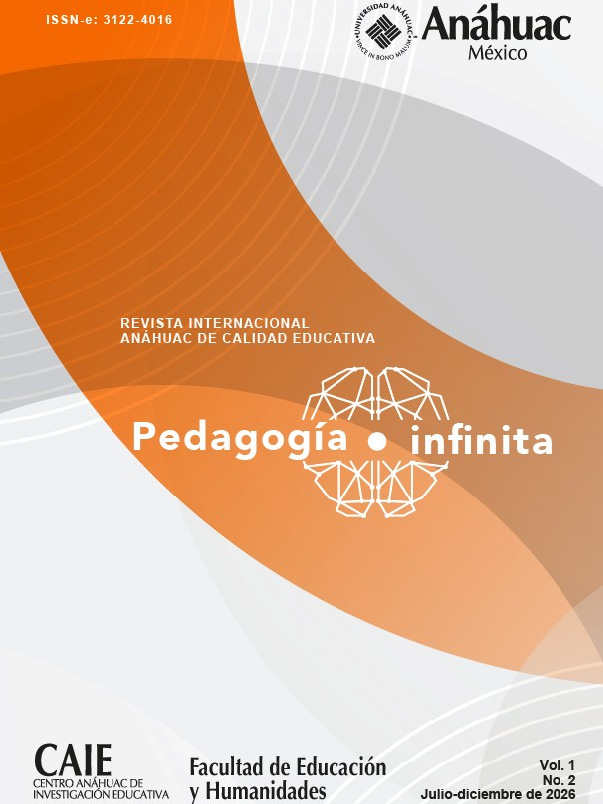
Contemporary education is undergoing a profound transformation driven by the convergence of technological advances, the need for training suited to increasingly complex societies, and the imperative to strengthen human development as the foundation of educational processes. In this context, the field of pedagogy faces the challenge of generating knowledge that not only explains ongoing changes but also guides new approaches to teaching, learning, assessment, and research. The ten articles in this issue offer a broad, complementary view of these challenges, weaving together conceptual perspectives, empirical research, methodological developments, and critical reflections that demonstrate the vitality of current educational research.
A primary thematic focus brings together studies aimed at strengthening learning from a holistic perspective. Contributions addressing conscious discipline, metacognition, and support programs for the transition to higher education share the understanding that academic development cannot be defined solely by the acquisition of subject-specific knowledge. Instead, they highlight the importance of fostering socio-emotional skills, self-regulation processes, metacognitive reflection, and autonomy as essential conditions for successful educational pathways. Employing diverse methodological approaches, these studies demonstrate that holistic development is a strategic component in meeting the demands of the contemporary educational landscape.
A second body of research addresses the transformation of pedagogical practices in settings characterized by the increasing integration of digital technologies. This area encompasses studies analyzing the redesign of university teaching, the development of technological tools for assessing soft skills, and perceptions regarding the use of generative artificial intelligence in educational processes. Far from viewing technology as an end, this research highlights the need to integrate it through didactic and curricular approaches that strengthen learning, foster active student participation, and expand the scope for evidence-based educational innovation.
Indeed, artificial intelligence emerges as a key topic in this volume. While some studies explore its potential to support learning and examine the perceptions of those beginning to incorporate it into their academic training, others offer a critical reflection on the ethical limits of its use when it replaces functions inherent to the teaching role—such as interpretation, feedback, and pedagogical judgment. This convergence of perspectives reveals that the true debate lies not in accepting or rejecting technology, but in establishing pedagogical criteria to guide its responsible, transparent, and ethically grounded use.
Educational assessment forms another key pillar of this issue. Various studies present evidence regarding the assessment of critical thinking in incoming students, the psychometric validation of instruments to measure reflective thinking, and a comparative analysis of structural methods applied to the study of latent factors in self-esteem scales. Collectively, these works demonstrate the growing methodological sophistication of educational research and reaffirm the importance of having valid, reliable, and conceptually sound instruments to understand complex phenomena associated with learning, cognitive development, and the psychological characteristics of students.
Beyond the diversity of subjects, methodologies, and theoretical approaches, the collected contributions share a common concern: understanding how to improve the quality of educational processes in a context of constant change. Pedagogical innovation, competency development, digital transformation, rigorous assessment, and ethical reflection emerge as inseparable dimensions of a pedagogy committed to fostering individuals capable of lifelong learning and critical participation in societies characterized by uncertainty and the rapid expansion of knowledge. This issue, therefore, serves as an invitation to reflect on the present and future of education from a scientific, critical, and interdisciplinary perspective. The research presented here does not offer definitive answers; rather, it raises new questions, proposes avenues for inquiry, and enriches an academic dialogue essential for understanding the challenges facing education in this century. In doing so, the journal “Pedagogía Infinita” reaffirms its commitment to disseminating high-quality knowledge, promoting research that contributes to strengthening pedagogy as a scientific field and consolidating educational practices that are increasingly relevant, innovative, and socially responsible.
Published:
2026-07-30
Full Issue
Artículos
La revista Pedagogía Infinita. Revista Internacional Anáhuac de Calidad Educativa nace en formato digital en el año 2025, aunque el proyecto se desarrolla en el marco de la celebración del LX Aniversario de la Universidad Anáhuac México, bajo un proceso editorial que exige una publicación periódica y de calidad científica. Su principal objetivo es el de propiciar la difusión de investigaciones pedagógicas nacionales e internacionales, con una periodicidad semestral.
Todas las contribuciones que publica están referidas al área temática de Ciencias Sociales y la categoría Educación; dentro de sus líneas específicas abarca: ciencias de la educación, pedagogía, didáctica, enseñanza de las disciplinas, evaluación educativa, liderazgo y administración de instituciones educativas, educación a distancia, formación continua del profesorado, inclusión educativa, integración de TIC, TAC y tecnologías generadoras aplicadas al proceso pedagógico.