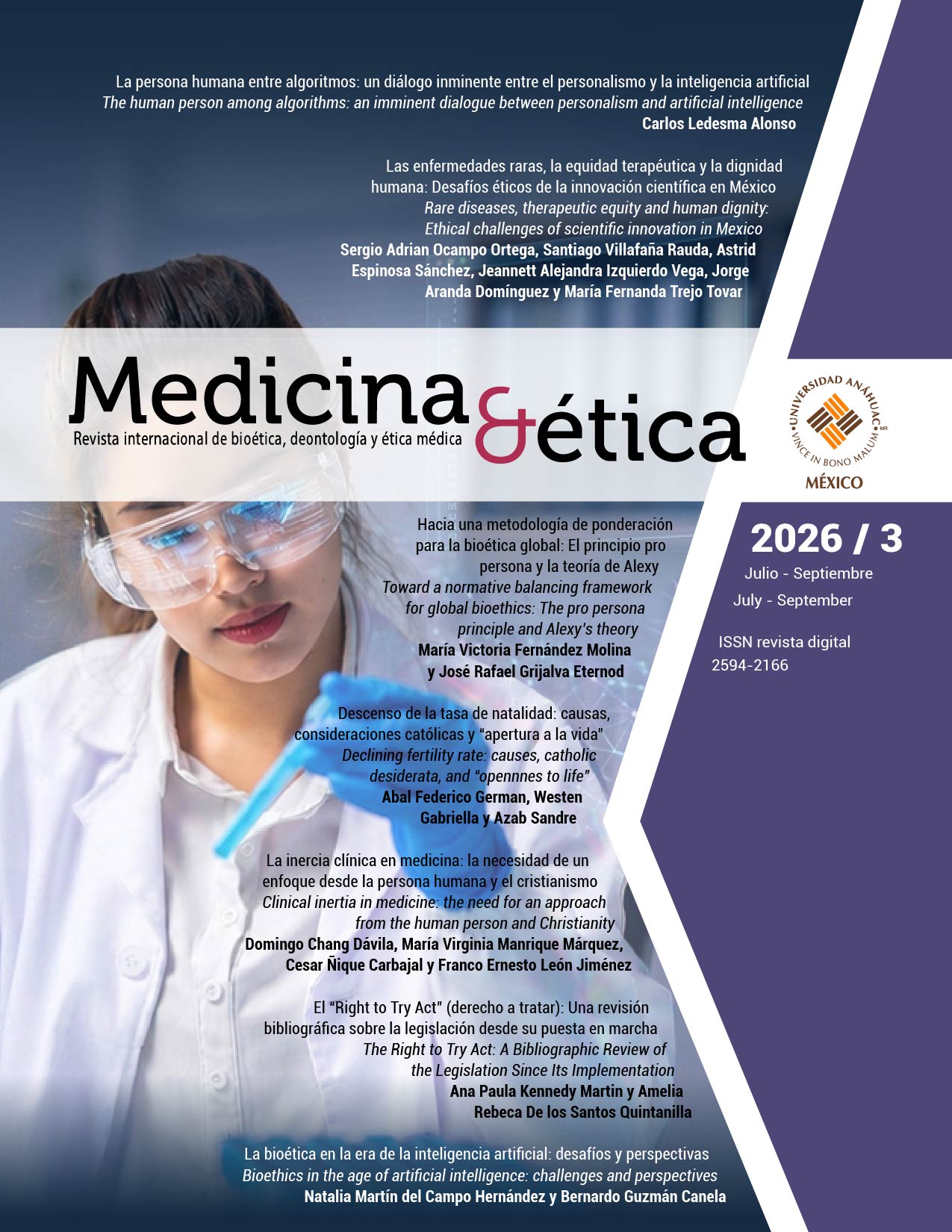
El "Right to Try Act" (derecho a tratar): una revisión bibliográfica sobre la legislación desde su puesta en marcha
DOI:
https://doi.org/10.36105/mye.2026v37n3.06Palabras clave:
bioética, derecho a tratar, right to try act, tratamientos experimentales, acceso ampliado de medicamentos, alimentos y administración de medicamentos, FDAResumen
El Right to Try Act (derecho a tratar) en Estados Unidos, autoriza el acceso a pacientes con enfermedades terminales a medicamentos experimentales sin aprobación ni intervención de la Food And Drug Administration (FDA) y sin la revisión de comités de bioética desde 2018, lo que ha generado controversias en torno al respeto a la autonomía del paciente y los riesgos derivados de su implementación. El objetivo principal del presente artículo es el de describir la evolución de la legislación sobre el Right to Try (derecho a tratar) en Estados Unidos a partir de una revisión de fuentes documentales. Se realizó una revisión bibliográfica de artículos académicos sobre el marco legal del Right to Try. Finalmente el Right To Try Act representa una respuesta compasiva frente a los pacientes con enfermedades terminales sin opciones de tratamiento, reforzando la libertad de decisión, sin embargo, conlleva riesgos regulatorios en el acceso por lo que se recomienda avanzar hacia modelos que permitan flexibilidad y protección a la vez.
Descargas
Referencias
1. Dighe A. Experimental Drug Access for Terminally-Ill Patients: A Review of the Right to Try Act. 2021. http://dx.doi.org/10.26153/tsw/43219
2. Agarwal R, Saltz LB. Understanding the right to try act. Clinical Cancer Research. 2020; 26(2):340-3. https://pubmed.ncbi.nlm.nih.gov/31666248/ DOI: https://doi.org/10.1158/1078-0432.CCR-19-2015
3. Trageser J. The “Right to Try” Law: What Does It Mean for Patients?; 2019. Disponible en: https://www.igliving.com/magazine/articles/IGL_2019-04_AR_The-Right-to-Try-Law-What-Does-It-Mean-for-Patients.pdf
4. Gabay M. RxLegal: a rapid review of right-to-try. Hospital Pharmacy. 2018; 53(4):234-5. https://doi.org/10.1177/0018578718783992 DOI: https://doi.org/10.1177/0018578718783992
5. Mellado J. Autonomía, consentimiento y responsabilidad. Parte 1: limitaciones del principio de autonomía como fundamento del consentimiento informado. Radiología. 2016; 58(5):343-51. https://doi.org/10.1016/j.rx.2016.06.009 DOI: https://doi.org/10.1016/j.rx.2016.06.009
6. Michaeli DT, Michaeli T, Albers S, Boch T, Michaeli JC. Special FDA designations for drug development: orphan, fast track, accelerated approval, priority review, and breakthrough therapy. The European journal of health economics: HEPAC: health economics in prevention and care. https://doi.org/10.1007/s10198-023-01639-x DOI: https://doi.org/10.1007/s10198-023-01639-x
7. Paradise J. Three Framing of” Faster” at the FDA and the Federal Right to Try. Wake Forest JL & Pol’y. 2020; 11:53. https://ssrn.com/abstract=3599624
8. Lin B. Federal right to try act: Heightened informed consent and price regulation measures will improve quality, autonomy, and exploitation issues. Hastings Bus LJ. 2020; 16:207. Disponible en: https://repository.uclawsf.edu/hastings_business_law_journal/vol16/iss2/6/
9. Lynch HF, Zettler PJ, Sarpatwari A. Promoting patient interests in implementing the Federal Right to Try Act. JAMA. 2018; 320(9):869-70. https://doi.org/10.1001/jama.2018.9880 DOI: https://doi.org/10.1001/jama.2018.9880
10. Carrieri D, Peccatori FA, Boniolo G. The ethical plausibility of the ‘Right To Try’ laws. Critical Reviews in Oncology/Hematology. 2018; 122:64-71. https://doi.org/10.1016/j.critrevonc.2017.12.014 DOI: https://doi.org/10.1016/j.critrevonc.2017.12.014
11. Borysowski J, Górski A. Compassionate use of unauthorized drugs: legal regulations and ethical challenges. European Journal of Internal Medicine. 2019; 65:12- 6. https://doi.org/10.1016/j.ejim.2019.04.008 DOI: https://doi.org/10.1016/j.ejim.2019.04.008
12. Lima AFdA, Machado FIdS. Physicians as choice architects: paternalism and respect for autonomy. Revista Bioética. 2021; 29:44-54. http://dx.doi.org/10.1590/1983-80422021291445 DOI: https://doi.org/10.1590/1983-80422021291445
13. Araujo LV, Gutiérrez LM. Toma de decisiones en el contexto de muerte digna desde los principios bioéticos de autonomía y beneficencia a la práctica clínica, 2022. Disponible en: https://apidspace.javeriana.edu.co/server/api/core/bitstreams/09fdda73-d334-4679-b621-4abdbdfb79d7/content
14. Papakonstantinou T, Kolettis T. Investigational Therapies and Patients’ Autonomy. Canadian Journal of Bioethics / Revue canadienne de bioéthique. 2020;3(3):115- 7. https://doi.org/10.7202/1073786ar DOI: https://doi.org/10.7202/1073786ar
15. Shayma CB, Karina CR, Roberto CR, editors. Los principios de la bioética médica como solución a los dilemas bioéticos que se producen en el actuar médico. aniversariocimeq2021; 2021. Disponible en: https://aniversariocimeq2021.sld.cu/index.php/ac2021/Cimeq2021/paper/viewFile/267/215
16. Magadán CE. Evolución Histórica de la Bioética Médica; 2023. Disponible en:
https://cibamanz.sld.cu/index.php/cibamanz/2023/paper/download/142/402
17. Mora FC, Tobler CA. Una aproximación arqueológica al concepto de justicia en los discursos de Beauchamp y Childress. Revista Colombiana de Bioética. 2024; 19(1). https://doi.org/10.18270/rcb.v19i1.4400 DOI: https://doi.org/10.18270/rcb.v19i1.4400
18. Manley H, Sisk BA, Master Z, Scott CT. Prescribing unproven cancer drugs: physician perspectives on expanded access and right to try. Journal of Law and the Biosciences. 2022; 9(2). https://doi.org/10.1093/jlb/lsac031 DOI: https://doi.org/10.1093/jlb/lsac031
19. Zettler ME, Jeune-Smith Y, Feinberg BA, Phillips Jr EG, Gajra A. Expanded access and right to try requests: The community Oncologist’s experience. JCO Oncology Practice. 2021; 17(11):e1719-e27. https://doi.org/10.1200/OP.20.00569 DOI: https://doi.org/10.1200/OP.20.00569
20. Smith C, Stout J, Adjei AA, Buckner J, Wentworth M, Tilburt J, et al. “I Think It’s Been Met With a Shrug:” Oncologists’ Views Toward and Experiences With Right- to-Try. JNCI: Journal of the National Cancer Institute. 2020; 113(6):735-41. https://doi.org/10.1093/jnci/djaa137 DOI: https://doi.org/10.1093/jnci/djaa137
21. Zoffer WM. Recent Legislation That Secured a” Right to Try” Unapproved Drugs: Why the” Fuss” over a” Fix” of What” Ain’t Broke”? Wake Forest JL & Pol’y. 2020; 11:119. http://dx.doi.org/10.2139/ssrn.3511840 DOI: https://doi.org/10.2139/ssrn.3511840
22. Chapman CR, Belli HM, Leach D, Shah LD, Bateman-House A. A survey of pediatric hematologists/oncologists’ perspectives on single patient Expanded Access and Right to Try. Medicine Access @ Point of Care; 2021. https://doi.org/10.1177/23992026211005991 DOI: https://doi.org/10.1177/23992026211005991
23. Folkers K, Chapman C, Redman B. Federal Right to Try: where is it going? Hastings Center Report. 2019; 49(2):26-36. https://doi.org/10.1002/hast.990 DOI: https://doi.org/10.1002/hast.990
24. Walker S. Expanded access versus right-to-try. SAGE Publications Sage CA: Los Angeles, CA; 2020. https://doi.org/10.1177/0018578719883801 DOI: https://doi.org/10.1177/0018578719883801
25. Brown B, Ortiz C, Dubé K. Assessment of the right-to-try law: the pros and the cons. Journal of Nuclear Medicine. 2018; 59(10):1492-3. https://doi.org/10.2967/jnumed.118.216945 DOI: https://doi.org/10.2967/jnumed.118.216945
26. Svarch-Pérez AE, Molina-Gasman AM, Enríquez-Ríos N, Olivares-Trejo MP, Molina-Leza JF, Alcocer-Varela JC. Eficiencia en las autorizaciones sanitarias de medicamentos por la Cofepris, 2019-2022. salud pública de méxico. 2024; 66(3):296- 303. https://doi.org/10.21149/15286 DOI: https://doi.org/10.21149/15286
27. Simplificación D. Revisión y análisis de la guía para el sometimiento para protocolo de investigación en seres humanos, homoclave COFEPRIS 04-010 ay propuesta: Universidad Nacional Autónoma de México; 2020. Disponible en: https://ru.dgb.unam.mx/server/api/core/bitstreams/7a8b33a4-ce6e-445c-9a7c-a096d26903b9/content
Descargas
Publicado
Número
Sección
Licencia
Derechos de autor 2026 Ana Paula Kennedy-Martin, Amelia Rebeca De los Santos-Quintanilla

Esta obra está bajo una licencia internacional Creative Commons Atribución-NoComercial-CompartirIgual 4.0.
Medicina y Ética se distribuye bajo Licencia Creative Commons Atribución-NoComercial-CompartirIgual 4.0 Internacional.
El autor conserva los derechos patrimoniales sin restricciones y garantiza a la revista el derecho de ser la primera publicación del trabajo. El autor es libre de depositar la versión publicada en cualquier otro medio, como un repositorio institucional o en su propio sitio web.