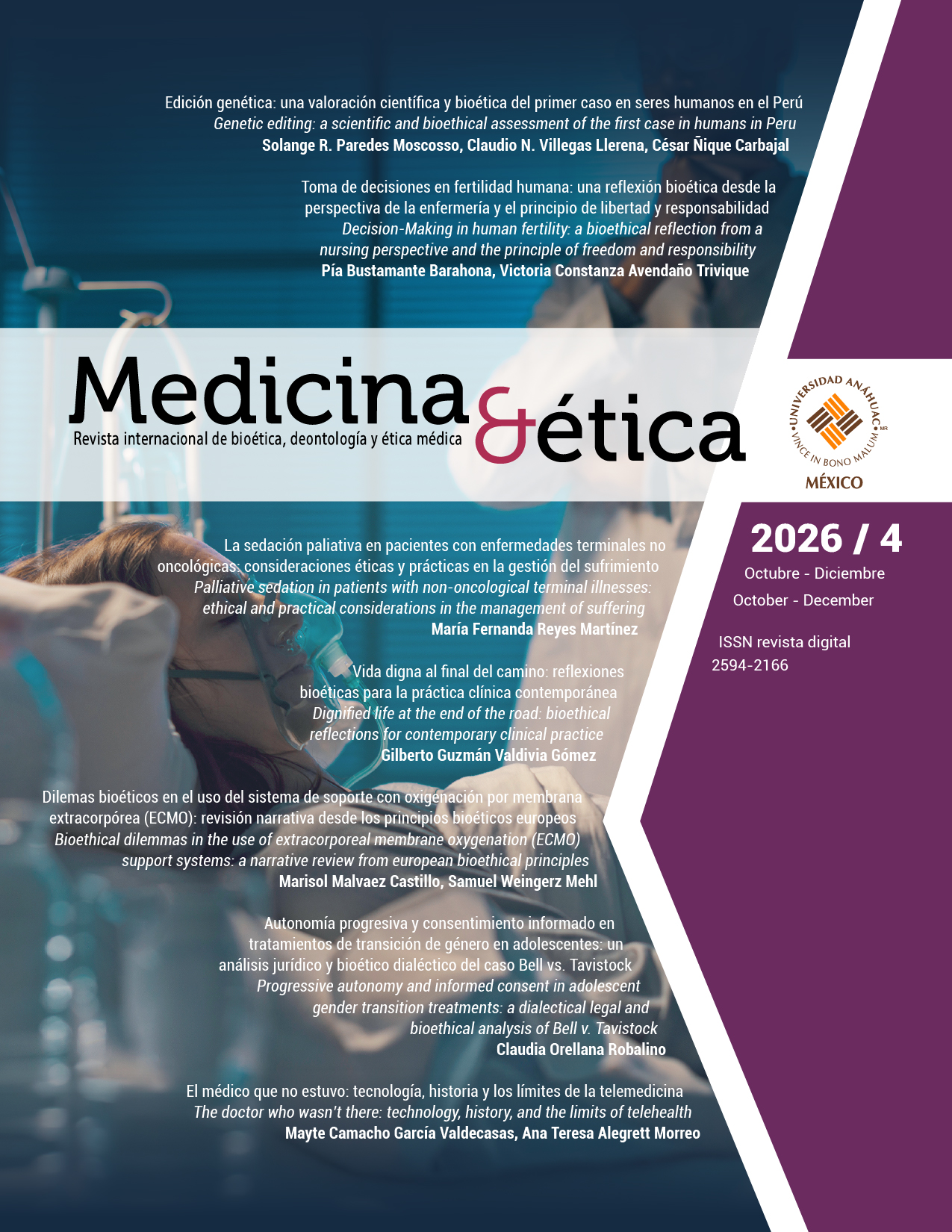
Edición genética: una valoración científica y bioética del primer caso en seres humanos en el Perú
DOI:
https://doi.org/10.36105/mye.2026v37n4.01Palabras clave:
edición génica, CRISPR, terapia celular, salud, bioética personalistaResumen
La técnica de edición génica, CRISPR/Cas9, es una herramienta revolucionaria de alcance transdisciplinar, tiene el potencial de transformar diversos campos del saber. El presente trabajo aborda la definición de CRISPR/Cas9, explora, desde una perspectiva biomédica, sus ventajas y desventajas a nivel laboratorial y clínico, estudiando su aplicabilidad en investigación básica y traslacional, y en terapias ya aprobadas en humanos. En ese contexto, se comenta en este trabajo algunas experiencias en CRISPR reportadas en nuestro país, haciendo énfasis en la primera experiencia de investigación de CRISPR/Cas9 en células humanas. En dicho estudio, esta técnica se utilizó para el tratamiento con edición génica y terapia celular autóloga de una forma hereditaria de retinosis pigmentaria (RP), encontrada hasta ahora solo en pacientes de una comunidad peruana. Asimismo, se menciona el análisis ético sobre el uso y aplicación de la edición génica con esta herramienta, en base a los principios personalistas de la bioética.
Descargas
Referencias
1. Wang JY, Doudna JA. CRISPR technology: A decade of genome editing is only the beginning. Science. 2023; 379(6629):eadd8643. https://doi.org/10.1126/science.add8643
2. Liu Q, He D, Xie L. Prediction of off-target specificity and cell-specific fitness of CRISPR-Cas system using attention boosted deep learning and network-based gene feature. PLoS Comput Biol. 2019; 15(10):e1007480. https://doi.org/10.1371/journal.pcbi.1007480 DOI: https://doi.org/10.1371/journal.pcbi.1007480
3. Wu Q, Cui L, Liu Y, Li R, Dai M, Xia Z. CRISPR-Cas systems target endogenous genes to impact bacterial physiology and alter mammalian immune responses. Mol Biomed. 2022; 3(1):22. DOI: 10.1186/s43556-022-00084-1 DOI: https://doi.org/10.1186/s43556-022-00084-1
4. Barrangou R, Fremaux C, Deveau H, Richards M, Boyaval P, Moineau S. CRISPR provides acquired resistance against viruses in prokaryotes. Science. 2007; 315(5819):1709-12. https://doi.org/10.1186/s43556-022-00084-1 DOI: https://doi.org/10.1126/science.1138140
5. Jinek M, Chylinski K, Fonfara I, Hauer M, Doudna JA, Charpentier E. A programmable dual-RNA–guided DNA endonuclease in adaptive bacterial immunity. Science. 2012; 337(6096):816-21. https://doi.org/10.1126/science.1225829 DOI: https://doi.org/10.1126/science.1225829
6. Ishino Y, Shinagawa H, Makino K, Amemura M, Nakata A. Nucleotide sequence of the iap gene, responsible for alkaline phosphatase isozyme conversion in Escherichia coli, and identification of the gene product. J Bacteriol. 1987; 169(12):5429- 33. https://doi.org/10.1128/jb.169.12.5429-5433.1987 DOI: https://doi.org/10.1128/jb.169.12.5429-5433.1987
7. Brouns SJJ, Jore MM, Lundgren M, Westra ER, Slijkhuis RJH, Snijders APL. Small CRISPR RNAs guide antiviral defense in prokaryotes. Science. 2008; 321(5891):960-4. https://doi.org/10.1126/science.1159689 DOI: https://doi.org/10.1126/science.1159689
8. Pacesa M, Pelea O, Jinek M. Past, present, and future of CRISPR genome edi- ting technologies. Cell. 2024; 187(5):1076-100. https://doi.org/10.1016/j.cell.2024.01.042 DOI: https://doi.org/10.1016/j.cell.2024.01.042
9. Jasin M. Genetic manipulation of genomes with rare-cutting endonucleases. Trends Genet. 1996; 12(6):224-8. https://doi.org/10.1016/0168-9525(96)10019-6 DOI: https://doi.org/10.1016/0168-9525(96)10019-6
10. Doudna JA, Charpentier E. Genome editing. The new frontier of genome engineering with CRISPR-Cas9. Science. 2014; 346(6213):1258096. https://doi.org/10.1126/science.1258096 DOI: https://doi.org/10.1126/science.1258096
11. WangJ Y, Doudna JA. CRISPR technology: A decade of genome editing is only the beginning. Science. 2023; 379(6629):eadd8643. https://doi.org/10.1126/science.add8643 DOI: https://doi.org/10.1126/science.add8643
12. Bravo JPK , Liu MS, Hibshman GN, Dangerfield TL, Jung K, Mc Cool RS. Structural basis for mismatch surveillance by CRISPR-Cas9. Nature. 2022; 603(7900):343- 7. https://doi.org/10.1038/s41586-022-04655-8 DOI: https://doi.org/10.1038/s41586-022-04470-1
13. Lin S, Staahl BT, Alla RK, Doudna JA. Enhanced homology-directed human ge- nome engineering by controlled timing of CRISPR/Cas9 delivery. eLife. 2014; 3:e04766. https://doi.org/10.7554/eLife.04766 DOI: https://doi.org/10.7554/eLife.04766
14. Boyle EA, Becker WR, Bai HB, Chen JS, Doudna JA, Greenleaf WJ. Quantification of Cas9 binding and cleavage across diverse guide sequences maps landscapes of target engagement. Sci Adv. 2021; 7(8):eabe5432. https://doi.org/10.1126/sciadv.abe5496 DOI: https://doi.org/10.1126/sciadv.abe5496
15. Pacesa M, Loeff L, Querques I, Muckenfuss LM, Sawicka M, Jinek M. R-loop formation and conformational activation mechanisms of Cas9. Nature. 2022; 609(7925):191-6. https://doi.org/10.1038/s41586-023-06779-x DOI: https://doi.org/10.1038/s41586-022-05114-0
16. Kleinstiver BP, Pattanayak V, Prew MS, Tsai SQ, Nguyen NT, Zheng Z.High-fidelity CRISPR-Cas9 nucleases with no detectable genome-wide off-target effects. Nature. 2016; 529(7587):490-5. https://doi.org/10.1038/nature16526 DOI: https://doi.org/10.1038/nature16526
17. Casini A, Olivieri M, Petris G, Montagna C, Reginato G, Maule G. A highly specific SpCas9 variant is identified by in vivo screening in yeast. Nat Biotechnol. 2018; 36(3):265-71. https://doi.org/10.1038/nbt.4066 DOI: https://doi.org/10.1038/nbt.4066
18. Vakulskas CA, Dever DP, Rettig GR, Turk R, Jacobi AM, Collingwood MA. A high-fidelity Cas9 mutant delivered as a ribonucleoprotein complex enables efficient gene editing in human hematopoietic stem and progenitor cells. Nat Med. 2018; 24(8):1216-24. https://doi.org/10.1038/s41591-018-0137-0 DOI: https://doi.org/10.1038/s41591-018-0137-0
19. Collias D, Beisel CL. CRISPR technologies and the search for the PAM-free nuclease. Nat Commun. 2021; 12(1):555. https://doi.org/10.1038/s41467-020-20633-y DOI: https://doi.org/10.1038/s41467-020-20633-y
20. Gleditzsch D, Pausch P, Müller-Esparza H, Özcan A, Guo X, Bange G. PAM identification by CRISPR-Cas effector complexes: Diversified mechanisms and structures. RNA Biol. 2019; 16(4):504-17. https://doi.org/10.1080/15476286.2018.1504546 DOI: https://doi.org/10.1080/15476286.2018.1504546
21. Ceccaldi R, Sarangi P, D’Andrea AD. The Fanconi anaemia pathway: New players and new functions. Nat Rev Mol Cell Biol. 2016; 17(6):337-49. https://doi.org/10.1038/nrm.2016.48 DOI: https://doi.org/10.1038/nrm.2016.48
22. Lieber MR. The mechanism of human nonhomologous DNA end joining. J Biol Chem. 2008; 283(1):1-5. https://doi.org/10.1074/jbc.R700039200 DOI: https://doi.org/10.1074/jbc.R700039200
23. Liao H, Wu J, Van Dusen NJ, Li Y, Zheng Y.CRISPR-Cas9-mediated homology-di-rected repair for precise gene editing. Mol Ther Nucleic Acids. 2024; 35(4):102344. https://doi.org/10.1016/j.omtn.2024.102344 DOI: https://doi.org/10.1016/j.omtn.2024.102344
24. Moynahan ME, Jasin M. Mitotic homologous recombination maintains genomic stability and suppresses tumorigenesis. Nat Rev Mol Cell Biol. 2010; 11(3):196- 207. https://doi.org/10.1038/nrm2851 DOI: https://doi.org/10.1038/nrm2851
25. Heyer WD, Ehmsen KT, Liu J. Regulation of homologous recombination in eukaryotes. Annu Rev Genet. 2010; 44:113-39. https://doi.org/10.1146/annurev-genet-051710-150955 DOI: https://doi.org/10.1146/annurev-genet-051710-150955
26. Rouet P, Smih F, Jasin M. Expression of a site-specific endonuclease stimulates homologous recombination in mammalian cells. Proc Natl Acad Sci U S A. 1994; 91(13):6064-8. https://doi.org/10.1073/pnas.91.13.6064 DOI: https://doi.org/10.1073/pnas.91.13.6064
27. Yang H, Ren S, Yu S, Pan H, Li T, Ge S. Methods favoring homology-directed repair choice in response to CRISPR/Cas9 induced-double strand breaks. Int J Mol Sci. 2020; 21(18):6861. https://doi.org/10.3390/ijms21186461 DOI: https://doi.org/10.3390/ijms21186461
28. Paquet D, Kwart D, Chen A, Sproul A, Jacob S, Teo S. Efficient introduction of specific homozygous and heterozygous mutations using CRISPR/Cas9. Nature. 2016; 533(7601):125-9. https://doi.org/10.1038/nature17664 DOI: https://doi.org/10.1038/nature17664
29. Richardson CD, Ray GJ, DeWitt MA, Curie GL, Corn JE. Enhancing homology-directed genome editing by catalytically active and inactive CRISPR-Cas9 using asymmetric donor DNA. Nat Biotechnol. 2016; 34(3):339-44. https://doi.org/10.1038/nbt.3481 DOI: https://doi.org/10.1038/nbt.3481
30. Yeh CD, Richardson CD, Corn JE. Advances in genome editing through control of DNA repair pathways. Nat Cell Biol. 2019; 21(12):1468-78. https://doi.org/10.1038/s41556-019-0425-z DOI: https://doi.org/10.1038/s41556-019-0425-z
31. Yang D, Scavuzzo MA, Chmielowiec J, Sharp R, Bajic A, Borowiak M.Enrichment of G2/M cell cycle phase in human pluripotent stem cells enhances HDR-mediated gene repair with customizable endonucleases. Sci Rep. 2016; 6:21264. https://doi.org/10.1038/srep21264 DOI: https://doi.org/10.1038/srep21264
32. Wienert B, Nguyen DN, Guenther A, Feng SJ, Locke MN, Wyman SK. Timed inhibition of CDC7 increases CRISPR-Cas9 mediated templated repair. Nat Com- mun. 2020; 11(1):2109. https://doi.org/10.1038/s41467-020-15845-1 DOI: https://doi.org/10.1038/s41467-020-15845-1
33. Lin Y, Cradick TJ, Brown MT, Deshmukh H, Ranjan P, Sarode N. CRISPR/Cas9 systems have off-target activity with insertions or deletions between target DNA and guide RNA sequences. Nucleic Acids Res. 2014; 42(11):7473-85. https://doi.org/10.1093/nar/gku402 DOI: https://doi.org/10.1093/nar/gku402
34. Riesenberg S, Kanis P, Macak D, Wollny D, Düsterhöft D, Kowalewski J. Efficient high-precision homology-directed repair-dependent genome editing by HDRobust. Nat Methods. 2023; 20(9):1388-99. https://doi.org/10.1038/s41592-023-01949-1 DOI: https://doi.org/10.1038/s41592-023-01949-1
35. Charlesworth CT, Deshpande PS, Dever DP, Camarena J, Lemgart VT, Cromer MK. Identification of preexisting adaptive immunity to Cas9 proteins in humans. Nat Med. 2019; 25(2):249-54. https://doi.org/10.1038/s41591-018-0326-x DOI: https://doi.org/10.1038/s41591-018-0326-x
36. Wagner DL, Amini L, Wendering DJ, Burkhardt LM, Akyüz L, Reinke P. High prevalence of Streptococcus pyogenes Cas9-reactive T cells within the adult human population. Nat Med. 2019; 25(2):242-8. https://doi.org/10.1038/s41591-018-0204-6 DOI: https://doi.org/10.1038/s41591-018-0204-6
37. Hakim CH, Kumar SRP, Pérez-López DO, Wasala NB, Zhang D, Yue Y.Cas9-specific immune responses compromise local and systemic AAV CRISPR therapy in multiple dystrophic canine models. Nat Commun. 2021; 12(1):6769. https://doi.org/10.1038/s41467-021-26830-7 DOI: https://doi.org/10.1038/s41467-021-26830-7
38. Ferdosi SR, Ewaisha R, Moghadam F, Krishna S, Park JG, Ebrahimkhani MR. Multifunctional CRISPR-Cas9 with engineered immuno silenced human T cell epitopes. Nat Commun. 2019; 10(1):1842. https://doi.org/10.1038/s41467-019-09693-x DOI: https://doi.org/10.1038/s41467-019-09693-x
39. Doudna JA. The promise and challenge of therapeutic genome editing. Nature. 2020; 578(7794):229-36. https://doi.org/10.1038/s41586-020-1978-5 DOI: https://doi.org/10.1038/s41586-020-1978-5
40. Wu X, Scott DA, Kriz AJ, Chiu AC, Hsu PD, Dadon DB. Genome-wide binding of the CRISPR endonuclease Cas9 in mammalian cells. Nat Biotechnol. 2014; 32(7):670-6. https://doi.org/10.1038/nbt.2889 DOI: https://doi.org/10.1038/nbt.2889
41. Kosicki M, Tomberg K, Bradley A. Repair of double-strand breaks induced by CRISPR–Cas9 leads to large deletions and complex rearrangements. Nat Biotechnol. 2018; 36(8):765-71. https://doi.org/10.1038/nbt.4192 DOI: https://doi.org/10.1038/nbt.4192
42. Haapaniemi E, Botla S, Persson J, Schmierer B, Taipale J. CRISPR–Cas9 genome editing induces a p53-mediated DNA damage response. Nat Med. 2018; 24(7):927-30. https://doi.org/10.1038/s41591-018-0049-z DOI: https://doi.org/10.1038/s41591-018-0049-z
43. Modell AE, Lim D, Nguyen TM, Sreekanth V, Choudhary A. CRISPR-based therapeutics: Current challenges and future applications. Trends Pharmacol Sci. 2022; 43(2):151-61. https://doi.org/10.1016/j.tips.2021.10.012 DOI: https://doi.org/10.1016/j.tips.2021.10.012
44. Cappell KM, Kochenderfer JN. Long-term outcomes following CAR T cell therapy: What we know so far. Nat Rev Clin Oncol. 2023; 20(6):359-71. https://doi.org/10.1038/s41571-023-00754-1 DOI: https://doi.org/10.1038/s41571-023-00754-1
45. Frangoul H, Altshuler D, Cappellini MD, Chen YS, Domm J, Eustace BK. CRIS- PR-Cas9 gene editing for sickle cell disease and β-thalassemia. N Engl J Med. 2021; 384(3):252-60. https://doi.org/10.1056/NEJMoa2031054 DOI: https://doi.org/10.1056/NEJMoa2031054
46. Song P, Zhang Q, Xu Z, Shi Y, Jing R, Luo D. CRISPR/Cas-based CAR-T cells: production and application. Biomark Res. 2024; 12(1):54. https://doi.org/10.1186/s40364-024-00602-z DOI: https://doi.org/10.1186/s40364-024-00602-z
47. Chiesa R, Georgiadis C, Syed F, Zhan H, Etuk A, Gkazi SA. Base-edited CAR7 T cells for relapsed T-cell acute lymphoblastic leukemia. N Engl J Med. 2023; 389(10):899-910. https://doi.org/10.1056/NEJMoa2300709 DOI: https://doi.org/10.1056/NEJMoa2300709
48. Shapiro AMJ, Thompson D, Donner TW, Bellin MD, Hsueh W, Pettus J. Insulin expression and C-peptide in type 1 diabetes subjects implanted with stem cell-de-rived pancreatic endoderm cells in an encapsulation device. Cell Rep Med. 2021; 2(12):100466. https://doi.org/10.1016/j.xcrm.2021.100466 DOI: https://doi.org/10.1016/j.xcrm.2021.100466
49. Lee RG, Mazzola AM, Braun MC, Platt C, Vafai SB, Kathiresan S. Efficacy and safety of an investigational single-course CRISPR base-editing therapy targeting PCSK9 in nonhuman primate and mouse models. Circulation. 2023; 147(3):242-53. https://doi.org/10.1161/CIRCULATIONAHA.122.062132 DOI: https://doi.org/10.1161/CIRCULATIONAHA.122.062132
50. Walters M, Frangoul H, McKinney C, Pineiro L, Mapara M, Dalal J. Reni-Cel, an investigational AsCas12a gene-edited cell medicine, led to sustained hemoglobin normalization and increased fetal hemoglobin in patients with severe sickle cell disease treated in the RUBY trial. Transplant Cell Ther. 2025; 31(2):S21-2. https://doi.org/10.1016/j.jtct.2025.01.039 DOI: https://doi.org/10.1016/j.jtct.2025.01.039
51. Patsali P, Kleanthous M, Lederer CW. Disruptive technology: CRISPR/Cas-based tools and approaches. Mol Diagn Ther. 2019; 23(2):187-200. https://doi.org/10.1007/s40291-019-00391-4 DOI: https://doi.org/10.1007/s40291-019-00391-4
52. Jeong SH, Lee HJ, Lee SJ. Recent advances in CRISPR-Cas technologies for synthetic biology. J Microbiol. 2023; 61(1):13-36. https://doi.org/10.1007/s12275-022-00005-5 DOI: https://doi.org/10.1007/s12275-022-00005-5
53. Choubisa V. CRISPR-Cas9 off-target predictions using CNN and double CNN: Comparative analysis. Int J Sci Res Arch. 2024; 12(1):1074-80. https://doi.org/10.30574/ijsra.2024.12.1.0927 DOI: https://doi.org/10.30574/ijsra.2024.12.1.0927
54. Uddin F, Rudin CM, Sen T. CRISPR gene therapy: Applications, limitations, and implications for the future. Front Oncol. 2020; 10:1387. https://doi.org/10.3389/fonc.2020.01387 DOI: https://doi.org/10.3389/fonc.2020.01387
55. Cui Z, Lin L, Zong Y, Chen Y, Wang S. Precision gene editing using deep learning: A case study of the CRISPR-Cas9 editor. Appl Comput Eng. 2024; 64(1):134-41. https://doi.org/10.54254/2755-2721/64/20241357 DOI: https://doi.org/10.54254/2755-2721/64/20241357
56. CONCYTEC/FONDECYT. Resumen de los 190 Proyectos de Investigación Aplicada y Desarrollo Tecnológico. Lima: CONCYTEC; 2019.
57. Kamde SP, Anjankar A. Retinitis pigmentosa: Pathogenesis, diagnostic findings, and treatment. Cureus. 2023 Oct 30; 15(10):e47961. https://doi.org/10.7759/cureus.48006 DOI: https://doi.org/10.7759/cureus.48006
58. Ledford H, Callaway E. Pioneers of revolutionary CRISPR gene editing win chemistry Nobel. Nature. 2020; 586(7829):346-7. https://doi.org/10.1038/d41586-020-02765-9 DOI: https://doi.org/10.1038/d41586-020-02765-9
59. CONCYTEC. Científicos peruanos desarrollan tecnología para diagnóstico rápido y preciso de enfermedades infecciosas [Internet]. Lima: CONCYTEC; 2020 [citado febrero de 2026].
60. Dueñas E, Nakamoto JA, Cabrera-Sosa L, Huaihua P, Cruz M, Arévalo J. Novel CRISPR-based detection of Leishmania species. Front Microbiol. 2022; 13:1044431. https://doi.org/10.3389/fmicb.2022.958693 DOI: https://doi.org/10.3389/fmicb.2022.958693
61. Proyecto de Fortalecimiento del SINACTI/ProCiencia. Disminución de la absorción del cadmio en el cacao peruano mediante la edición genética de sus transportadores empleando la tecnología CRISPR-Cas9 (Registro: N.° 026 propuesta_60208) [Internet]. Lima: ProCiencia; 2019 [citado 18 febrero de 2026]. Disponible en: https://proyectofortalecimientodelsinacti.prociencia.gob.pe/investigacion/disminucion-de-la-absorcion-del-cadmio-en-el-cacao-peruano-mediante-la-edicion-genetica-de-sus-transportadores-empleando-la-tecnologia-crispr-cas9/
62. Paredes-Moscosso SR, Villegas-Llerena C, Quispe-Bravo BE, Buleje J, Gueva- ra-Fujita ML, Fujita R. Abstract 6338: CRISPR/Cas9 in vitro modelling of a VUS mutation found in Peruvian patients diagnosed with hereditary breast cancer. Cancer Res. 2025; 85(8 Suppl 1):6338. https://doi.org/10.1158/1538-7445.AM2025-6338 DOI: https://doi.org/10.1158/1538-7445.AM2025-6338
63. Fráncio L, Freitas MV de, Matte U.CRISPR/Cas patents and health-related publications in South America. An Acad Bras Cienc. 2023; 95(2):e20220475. https://doi.org/10.1590/0001-3765202320220629 DOI: https://doi.org/10.1590/0001-3765202320220629
64. Ñique C, Cervera M, Díaz R, Domínguez C. Principios bioéticos en el contexto de la pandemia de COVID-19. Rev Med Hered. 2020; 31(4):255-65. https://www.redalyc.org/articulo.oa?id=338065627009 DOI: https://doi.org/10.20453/rmh.v31i4.3860
65. Santa María D Angelo R, Quiceno JD, Torres A, Perochena AC. [The CRIS- PR/Cas9 techniques applied to human genetic enhancement: a biotechnological, anthropological-philosophical and legal dialogue]. Cuad Bioet. 2020; 31(103):343-55.
66. Infante-López DV, Céspedes-Galvis MF, Wilches-Flórez ÁM. CRISPR-Cas9: el debate bioético más allá de la línea germinal. Pers Bioet. 2022; 25(2):e2526. https://doi.org/10.5294/pebi.2021.25.2.9 DOI: https://doi.org/10.5294/pebi.2021.25.2.9
67. Gómez-Tatay L, Aznar J. [CRISPR-CAS9. The greatest advancement in genetic edition techniques requires an ethical reflection]. Cuad Bioet. 2019;30(99):171-85.
68. Das S, Bano S, Kapse P, Kundu GC. CRISPR based therapeutics: A new paradigm in cancer precision medicine. Mol Cancer. 2022; 21(1):85. https://doi.org/10.1186/s12943-022-01552-6 DOI: https://doi.org/10.1186/s12943-022-01552-6
69. Ayanoğlu FB, Elçin AE, Elçin YM. Bioethical issues in genome editing by CRISPR-Cas9 technology. Turk J Biol. 2020; 44(2):110-20. https://doi.org/10.3906/biy-1912-52 DOI: https://doi.org/10.3906/biy-1912-52
70. Xu X, Liu C, Wang Y, Koivisto O, Zhou J, Shu Y. Nanotechnology-based delivery of CRISPR/Cas9 for cancer treatment. Adv Drug Deliv Rev. 2021; 176:113891. https://doi.org/10.1016/j.addr.2021.113891 DOI: https://doi.org/10.1016/j.addr.2021.113891
71. Adashi EY, Gruppuso PA, Cohen IG. CRISPR therapy of sickle cell disease: The dawning of the gene editing era. Am J Med. 2024; 137(5):390-2. https://doi.org/10.1016/j.amjmed.2023.12.018 DOI: https://doi.org/10.1016/j.amjmed.2023.12.018
72. Donoso RF, Gómez N, Rodríguez A. Edición genómica con CRISPR-Cas9 y su aplicación en trastornos genéticos. Rev Cubana Invest Bioméd. 2024; 42(Supl es- p):e3230. Disponible en: https://revibiomedica.sld.cu/index.php/ibi/article/view/3354
73. Ferreyra KA. Consideraciones éticas sobre CRISPR/Cas9: Uso terapéutico en embriones y futura gobernabilidad. Rev Bioét Der. 2022; (55):121-38. https://dx.doi.org/10.1344/rbd2021.54.36115 DOI: https://doi.org/10.1344/rbd2021.54.36115
74. Palacios Yabar ML. CRISPR/Cas9: Edición genética vs. bioética. Apuntes Bioét. 2019; 2(1):5-18. https://revistas.usat.edu.pe/index.php/apuntes/article/view/238/865?download=pdf DOI: https://doi.org/10.35383/apuntes.v2i1.238
75. Lorenzo D, Esquerda M, Palau F, Cambra FJ. Ethics and genomic editing using the CRISPR-Cas9 technique: Challenges and conflicts. Nanoethics. 2022; 16(3):313- 21. https://doi.org/10.1007/s11569-022-00425-y DOI: https://doi.org/10.1007/s11569-022-00425-y
76. DoudnaJ. CRISPR’sunwanted anniversary.Science.2019;366(6467):777.https://doi.org/10.1126/science.aba1751 DOI: https://doi.org/10.1126/science.aba1751
Descargas
Publicado
Número
Sección
Licencia
Derechos de autor 2026 Solange R. Paredes-Moscosso, Claudio N. Villegas-Llerena, César Ñique Carbajal

Esta obra está bajo una licencia internacional Creative Commons Atribución-NoComercial-CompartirIgual 4.0.
Medicina y Ética se distribuye bajo Licencia Creative Commons Atribución-NoComercial-CompartirIgual 4.0 Internacional.
El autor conserva los derechos patrimoniales sin restricciones y garantiza a la revista el derecho de ser la primera publicación del trabajo. El autor es libre de depositar la versión publicada en cualquier otro medio, como un repositorio institucional o en su propio sitio web.